Sodium Bicarbonate in the ICU Fails to Reduce Kidney Injury or Mortality, Breakthrough NEJM Study Finds
Clinical trial reveals that the substance does not reduce kidney risks or mortality in critically ill patients with metabolic acidosis and shock.
Metabolic acidosis is a frequent and severe complication in patients admitted to Intensive Care Units (ICUs). Traditionally, sodium bicarbonate infusions have been used to correct this excess acidity in the blood. However, an international clinical trial published in the prestigious The New England Journal of Medicine investigated the true efficacy of this intervention in critically ill adults receiving blood pressure support medication (vasopressors). The results demonstrated that sodium bicarbonate administration does not decrease the probability of persistent renal dysfunction or death at 30 days, reshaping clinical perspectives on its routine use.
Putting Clinical Practice to the Test
Metabolic acidosis severely affects organ function and is associated with high mortality rates and the need for dialysis. To evaluate the actual benefits of this alkalizing treatment, the SODa-BIC trial followed 500 patients distributed across 55 ICUs in seven different countries. Half of the sample received an intravenous infusion of sodium bicarbonate lasting up to five hours, while the other half received a placebo consisting exclusively of a 5% dextrose solution.
The researchers focused their analysis on a primary indicator: the occurrence of major adverse kidney events within a strict 30-day timeframe following the intervention. This composite outcome included mortality from any cause, the need to initiate renal-replacement therapy (dialysis), or the presence of persistent renal dysfunction.
Results and Healthcare Implications
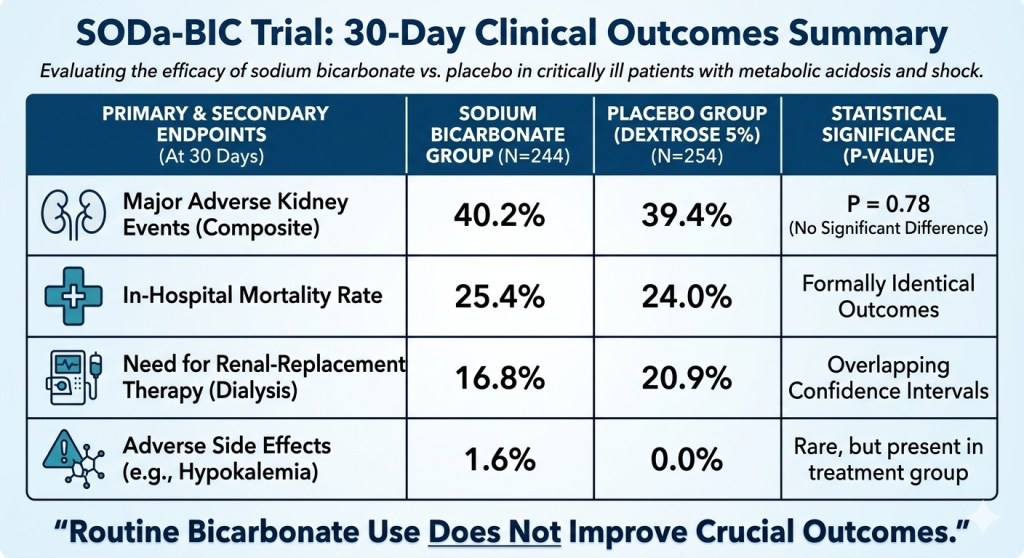
The final data revealed an absence of significant clinical benefits associated with the substance’s use. Approximately 40.2% of patients in the sodium bicarbonate group suffered a major adverse kidney event, a rate almost identical to the 39.4% recorded in the placebo group. This statistically insignificant difference proves that the treatment does not offer substantial additional protection to kidney function.
Additionally, overall hospital mortality remained largely unchanged: it stood at 25.4% for patients treated with sodium bicarbonate and 24.0% for the control group. Adverse reactions were globally rare, although four clinical cases were recorded in the sodium bicarbonate group, primarily related to a drop in blood potassium levels (hypokalemia).
What This Means for Patients and Families: The Laboratory vs. Real Recovery
When a loved one is in the ICU with a severe infection or shock, family members often hear doctors discuss blood acidity (pH). For decades, injecting sodium bicarbonate was seen as a logical fix to balance those numbers.
This breakthrough study teaches us an essential lesson about modern medicine: fixing an abnormal lab result quickly does not automatically translate into a patient’s recovery. While the sodium bicarbonate did correct blood acidity faster, it did not protect the kidneys from failing or change survival rates. In critical care, treatments must be judged by how they help the patient survive and recover, not just by how they alter numbers on a monitor.
What Experts Say & Limitations
The experts who led the investigation emphasize that, although sodium bicarbonate visibly corrected blood acidity much faster, this immediate laboratory effect did not translate into an improvement in patient-centered survival outcomes. As an essential scientific caveat, researchers note that the trial excluded patients for whom using the substance would be unsafe. Furthermore, they warn that the use of extra open-label bicarbonate administered off-protocol to some patients, alongside the great international variability in medical criteria for initiating dialysis, are factors that might have partially diluted the final results of the sample.
Conclusion and Recommendations
The administration of sodium bicarbonate in critically ill patients with shock and moderate metabolic acidosis offers no unequivocal advantages in protecting the kidneys or reducing short-term mortality. This new scientific evidence underscores the importance of applying ICU interventions only when they are proven to have a real impact on recovery. In the event of hospitalization due to critical illness, the ideal treatment should always be determined individually by the intensive care medical team, through a careful assessment of the specific clinical condition and risks of each patient.

