
New NEJM Study Challenges Guidelines: 5-Year Colonoscopy Interval Is Safe After High-Risk Polyp Removal
European study reveals extending surveillance to five years does not increase colorectal cancer risk after polyp removal.
Colorectal cancer is a highly prevalent disease, and screening colonoscopy has been vital in its prevention. Current clinical guidelines recommend that patients who have high-risk polyps (known as adenomas) removed repeat the exam after three years. However, a vast European clinical trial recently published in the prestigious The New England Journal of Medicine demonstrates that waiting five years for a surveillance exam is just as safe as maintaining the three-year interval. This clinical discovery could drastically reduce the burden of invasive exams on healthcare systems and improve patients’ quality of life.
Fewer Exams, the Same Protection
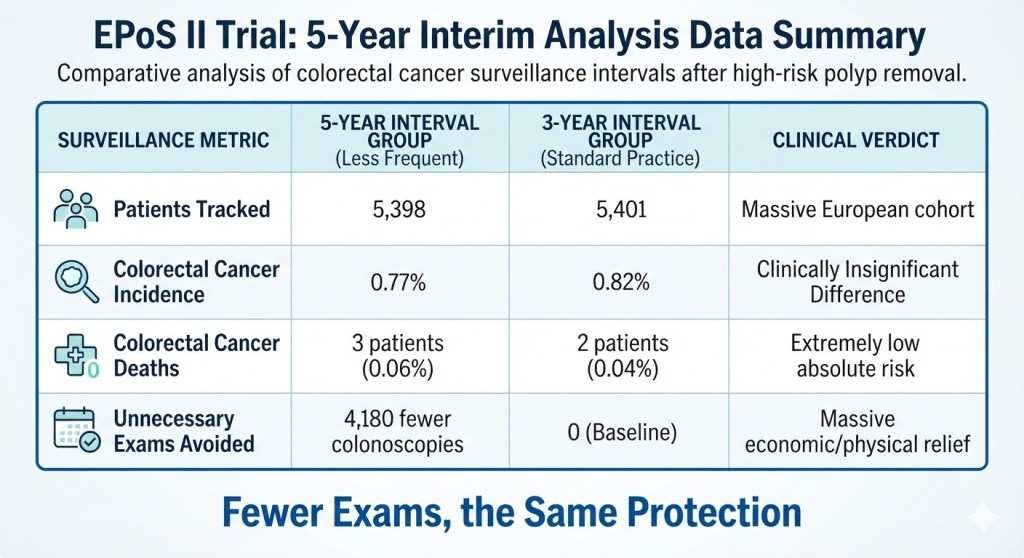
After the removal of intestinal polyps, some patients are considered by medical guidelines to be at high risk for developing new tumors. The EPoS study followed 10,799 patients with these clinical characteristics over more than five years, in a project involving eight European countries. To scientifically test the ideal surveillance interval, participants were divided into two groups: one underwent the follow-up colonoscopy at three years, and the other only at five years.
The cumulative incidence of cancer proved to be extremely low in both follow-up scenarios: 0.77% in the five-year interval and 0.82% in the three-year interval. The percentage difference was considered clinically insignificant, proving that delaying the exam does not compromise the patient’s health nor worsen the developmental stage of any eventually diagnosed cancer.
Impact on Quality of Life and Public Health
A colonoscopy is an expensive and invasive exam, and the required bowel preparation is frequently uncomfortable for the patient. In this scientific trial, the group assigned to the five-year surveillance avoided more than 4,180 unnecessary colonoscopies compared to the three-year surveillance group.
By proving that five-year surveillance is strictly safe, this research provides the groundwork to change global health guidelines. Patients would be spared unnecessary physical strain, and hospitals could optimize their resources much more effectively, actively directing endoscopic screening to populations that have never undergone the preventive exam.
What This Means for Patients: Do You Really Need That 3-Year Follow-Up?
If you have undergone a colonoscopy and had high-risk adenomas (polyps) completely removed, this breakthrough means you might safely avoid the stress, cost, and uncomfortable bowel preparation of an exam in just three years.
However, this five-year safety window applies only if:
- Your initial exam had an excellent bowel cleansing (allowing doctors to see everything clearly).
- The specialist successfully achieved the complete and verified removal of all detected polyps.
What Experts Say & Limitations
As an essential scientific caveat, researchers note that this is an interim analysis of a study designed to last ten years. Additionally, about 30% to 35% of the patients in the study ultimately did not undergo the planned surveillance exam at five years, which required applying rigorous statistical models (inverse probability weighting) to address the missing data and clinically validate the final results.
Conclusion and Recommendations
The data confirm that the five-year interval is safe and provides identical protection against colorectal cancer as the three-year interval after the removal of high-risk adenomas. Colonoscopy prevents diseases and saves lives, but anatomical surveillance needs are unique. It is strictly fundamental to consult your gastroenterologist to determine, in a personalized manner, the ideal interval for your next exam, basing the decision on your medical history and the characteristics of the removed polyps.

