
NEJM Study Shatters Myth: High Maternal Egg and Peanut Diet Fails to Prevent Infant Allergies
The landmark PrEggNut trial reveals that loading up on allergenic foods during pregnancy and breastfeeding does not lower a child’s allergy risk.
The development of food allergies in infants is a growing concern for families and the global medical community. Until recently, scientists explored the hypothesis that a mother’s ingestion of potential allergens during pregnancy and lactation could effectively “train” the fetus’s immune system early on and prevent future allergic reactions. However, a comprehensive Australian clinical trial published in the prestigious The New England Journal of Medicine has demonstrated that this practice is not effective. The research proved that high maternal consumption of eggs and peanuts does not reduce the chances of a child developing allergies to these specific foods within their first year of life.
The PrEggNut Study and the Maternal Diet
The study, named PrEggNut, followed 2,137 pregnant women whose future babies were at a high genetic risk for allergic diseases—meaning the unborn children had at least two biological family members already diagnosed with asthma, eczema, or food allergies. The objective was to rigorously test whether frequent exposure to allergens in the womb and, later, through breast milk, would generate immunological tolerance in the infant.
Participants were randomly assigned in a 1:1 ratio to two distinct groups from before the 23rd week of gestation until the fourth month postnatally during lactation:
- High Egg–Peanut Group: Instructed to adopt an allergen-rich diet, consuming at least 6 eggs and 60 peanuts weekly.
- Standard-Diet Group (Control): Maintained standard, restricted consumption, eating no more than 3 eggs and 30 peanuts per week.
Real Impact on Infant Health
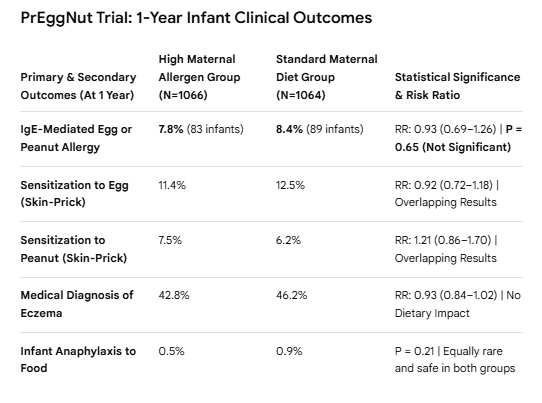
Upon turning one year old, the babies underwent standardized clinical assessments (skin-prick tests and oral food challenges) to verify the presence of IgE-mediated allergies, which involve the antibody responsible for immediate allergic reactions. The data revealed that 7.8% of the babies in the high maternal intake group developed an egg or peanut allergy, a rate almost identical to the 8.4% observed in the standard diet group.
The percentage difference between the groups was considered clinically insignificant, proving that intensive maternal dietary efforts did not translate into extra protection for the child’s immune system. Furthermore, the incidence of severe adverse reactions, such as cases of infant anaphylaxis, was equally low in both dietary scenarios.
What This Means for Mothers: Stop Forcing Complex Diets During Pregnancy
For decades, pregnant women have faced overwhelming, conflicting advice on what to eat to “shield” their babies from future conditions. The PrEggNut trial delivers a liberating message to expecting mothers: you do not need to force yourself to consume massive amounts of eggs or peanuts hoping to prevent infant allergies.
The human immune system is incredibly complex, and forcing an excessive allergen intake transplacentally or via breast milk does not change the allergic outcomes in clinical practice. Current pediatric science reinforces that the true window of opportunity for allergy prevention occurs directly in the baby’s own highchair, around 6 months of age, by introducing soft, cooked eggs and smooth peanut butter directly into the child’s solid diet according to standard safety guidelines.
What Experts Say & Limitations
The study’s authors point out that the strategy of inducing immunological tolerance transplacentally or through breast milk via high ingestion of eggs and peanuts did not prevent the onset of allergies in clinical practice. As an essential scientific caveat, the investigators note that the overall prevalence of allergies in the final sample was 8%, a number significantly lower than the 16% initially projected by researchers based on older population data. This lower overall allergy rate may have been influenced by the adoption of new pediatric guidelines, provided to the families in the study, which already encourage the early introduction of these allergens directly into the baby’s solid diet around six months of age.
Conclusion and Recommendations
The study’s findings confirm that forcing an excessive consumption of eggs and peanuts during pregnancy and lactation is not an effective strategy to shield a baby against food allergies. Current medical science reinforces that the best window of opportunity for prevention occurs during direct food introduction into the child’s own routine. Because immunological profiles and family health histories vary enormously, it is fundamental to consult your pediatrician or allergist to establish the safest time and method to introduce allergenic foods to your child.
References: Palmer, D.J., Campbell, D.E., Nanan, R., et al. (2026). Trial of a Maternal Diet Rich in Eggs and Peanuts to Reduce Infant Allergy. The New England Journal of Medicine, 395(11), 1090-1099. DOI: 10.1056/NEJMoa2605659

