
Blinatumomab Outperforms Chemotherapy in Childhood Leukemia
Study reveals immunotherapy increases survival and reduces severe infections in children with high-risk leukemia.
The treatment of childhood B-cell acute lymphoblastic leukemia (ALL) has reached a historic milestone. A clinical trial published in the prestigious The New England Journal of Medicine demonstrated that blinatumomab can successfully replace severe cycles of traditional chemotherapy. The breakthrough, focusing on newly diagnosed pediatric patients with high-risk disease, revealed that immunotherapy significantly increases event-free survival rates. This change represents a vital step forward in reducing toxicity and ensuring the success of pediatric oncological treatments.
A Leap in Survival and Safety
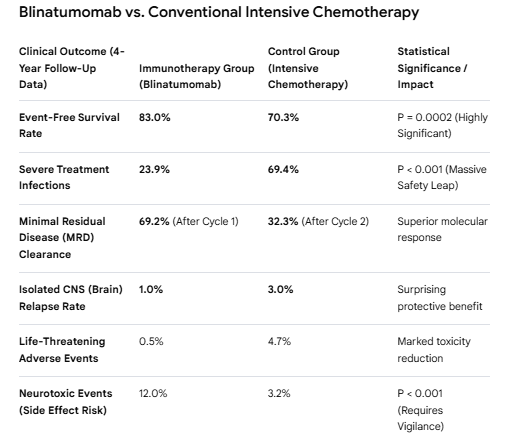
To evaluate the efficacy of this clinical substitution, the research consortium followed 709 children with high-risk B-cell ALL. Half of the group received two cycles of blinatumomab, while the other half (the control group) underwent two cycles of conventional intensive chemotherapy. The four-year results revealed that 83.0% of the children treated with the new medication remained free of severe events—such as relapse or death—compared to only 70.3% in the chemotherapy group.
Beyond higher efficacy in controlling the cancer, blinatumomab drastically reduced the rates of severe treatment-related infections, which plummeted from 69.4% to 23.9%. Life-threatening adverse events also dropped significantly, affecting 4.7% of the children undergoing chemotherapy versus only 0.5% of those on immunotherapy.
Direct Action Against Leukemia
Blinatumomab acts as a “bispecific T-cell engager”. In practice, the medication works as a bridge that specifically directs the patient’s own immune system to attack the CD19 antigen, a protein present on the surface of leukemic cells. This extremely selective action makes it possible to fight the disease while sparing the body from the widespread wear and tear caused by conventional cytotoxic drugs. The data proved that replacing the chemotherapy phase with this approach substantially improves outcomes and lowers the risk of fatal complications during disease remission.
What This Means for Families: An Intelligent Shield Against Pediatric Cancer
For parents facing a child’s leukemia diagnosis, the word “chemotherapy” often brings fear of severe side effects, extreme weakness, and dangerous hospital infections.
This historic medical advancement changes the narrative of pediatric oncology. Think of blinatumomab as an intelligent target seeker. Instead of aggressively impacting all fast-growing cells in a child’s body (like traditional chemotherapy does), this immunotherapy acts as a specialized bridge. It links the child’s healthy defense cells directly to the leukemia cells, destroying the cancer while leaving the rest of the body protected. The real-world impact is profound: children stay freer from cancer while suffering from nearly three times fewer severe infections during treatment.
What Experts Say & Limitations
Researchers highlight that this provides robust clinical evidence demonstrating that innovative therapies can replace highly toxic protocols without compromising the fight against pediatric cancer. However, as an indispensable scientific caveat, experts point out that blinatumomab requires strict vigilance for a specific side effect: neurotoxic events. Neurological symptoms were reported in 12.0% of patients in the immunotherapy group, compared to only 3.2% in the chemotherapy group. Additionally, doctors warn that the therapy requires prolonged monitoring of the child’s antibody (immunoglobulin) levels, since the medication depletes the patient’s healthy B cells.
Conclusion and Recommendations
The adoption of blinatumomab to replace intensive chemotherapy promises to redefine global protocols for high-risk childhood leukemia, curing more children while causing much less organic suffering. However, the exact indication, dosage, and management of potential neurological side effects strictly depend on the in-person evaluation of a pediatric oncologist. Continuous specialized medical follow-up is irreplaceable to ensure maximum safety, efficacy, and well-being in cancer treatment.
References: Schrappe, M., Locatelli, F., Valsecchi, M.G., et al. (2026). Blinatumomab for Replacing Chemotherapy in Pediatric Acute Lymphoblastic Leukemia. The New England Journal of Medicine, 395(11), 1075-1089. DOI: 10.1056/NEJMoa2604166

